

The Real EV Explained: Why Casino Bonuses Are a Trap
When we're testing and reviewing casinos, one of the most common selling points you'll encounter is a big deposit bonus. "100% up to $10,000" or "200% sign up bonus" sounds like a dream, more money to play with, right? But if you scratch the surface, you'll realize bonuses are usually one of the worst deals you can accept.
The key to understanding why lies in a single concept: Expected Value (EV). EV is what tells you, mathematically, whether a bet is worth it or not. In this article, we'll explain EV in plain terms for beginners, then go deep into the math to show why most crypto casino bonuses are negative. We'll use real examples from casinos like Stake and BC.Game to illustrate how wagering requirements crush your balance, and why you're better off looking for cashback or rakeback programs instead.
This is the mathematical foundation for our broader research into how crypto casino bonuses actually work. After proving the numbers here, we went further: reading the bonus terms of 100 crypto casinos to document what happens beyond the math, and investigating how casinos enforce those terms against players. The EV calculation is where it starts. It's not where it ends.
What is Expected Value (EV)?
Expected Value, or EV, is the long-term average of what you can expect to win or lose if you repeat a bet infinitely. It's a core idea not just in gambling, but in investing and decision-making.
The formula is:
EV = (Probability of Winning × Payout) – (Probability of Losing × Loss)
To visualize why high wagering kills value, here's how much of a $1 bonus you're expected to retain after n playthroughs at different house edges.
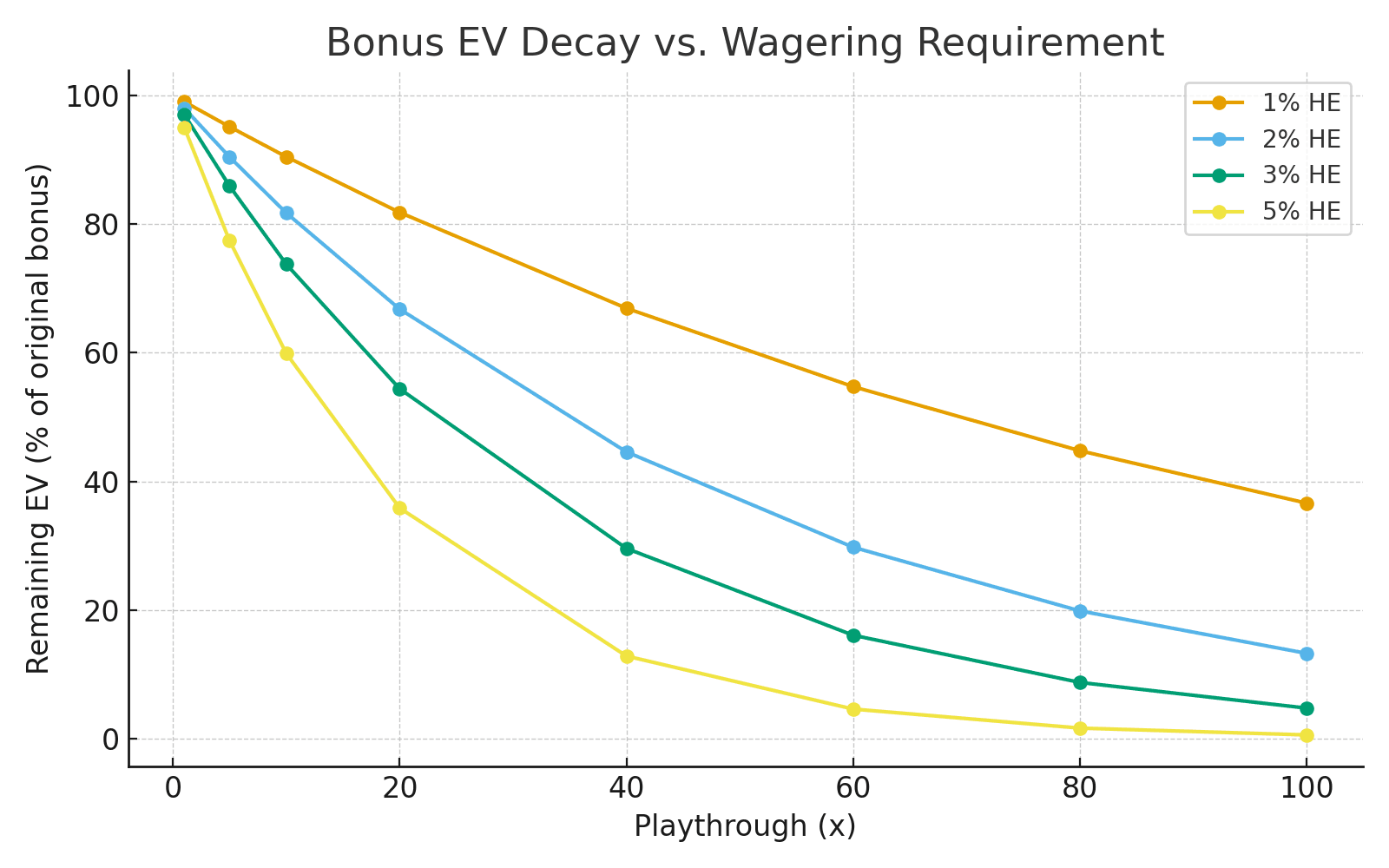 Bonus EV Decay vs. Wagering Requirement. Remaining expected value (as % of original bonus) after n rollovers. Even at a modest 3% house edge, 40x rollover leaves ~30% of EV; 60x ~16%; 80x ~9%; 100x ~5%. This is why large deposit bonuses with high wagering are negative EV compared to straightforward cashback or rakeback programs.
Example: A coin flip where you win $1 half the time and lose $1 the other half has an EV of 0. Over time, you break even.
Now, let's add a casino edge. If the house takes 5% of each bet, then every $1 wagered returns $0.95 on average. EV = –$0.05. That 5% is the house edge.
With bonuses, the trick is that casinos force you to wager multiple times before withdrawing. Each round, you lose a slice of your balance to the house edge. The more you're forced to wager, the lower your EV drops.
Example 1: 100% Match up to $10,000 with 40x Wagering
This is a standard offer we've seen countless times at brand new crypto casinos. Let's run the numbers:
- Deposit = $1,000
- Bonus = $1,000
- Total Balance = $2,000
- Wagering Requirement = 40 × Bonus = $40,000 in bets
Assume the average house edge is 3%. That means every $100 bet costs you $3 over time.
- Required Bets = $40,000
- Expected Loss = $40,000 × 0.03 = $1,200
So even though you "receive" $1,000 in bonus money, you're expected to lose $1,200 completing wagering.
👉 Net EV = –$200.
Instead of gaining, you're mathematically worse off than if you had skipped the bonus altogether.
Example 2: Stake Casino's 200% Bonus (40x Wagering)
Stake Casino, one of the best crypto gambling sites, offers new users a 200% sign up bonus up to $1,000 with 40x wagering. Let's say you deposit $500:
- Deposit = $500
- Bonus = $1,000
- Total Balance = $1,500
- Wagering Requirement = $1,000 × 40 = $40,000
Same 3% house edge applies:
- Expected Loss = $1,200
Here's the kicker: whether the match is 100%, 120%, or 200%, the math doesn't change. The larger the bonus, the bigger the wagering, and the more your EV suffers.
👉 The bonus percentage doesn't change the fact that the EV is negative.
Here's a comparison of how different bonus sizes impact expected loss when you deposit $1,000 with a 40x rollover at a 3% house edge.
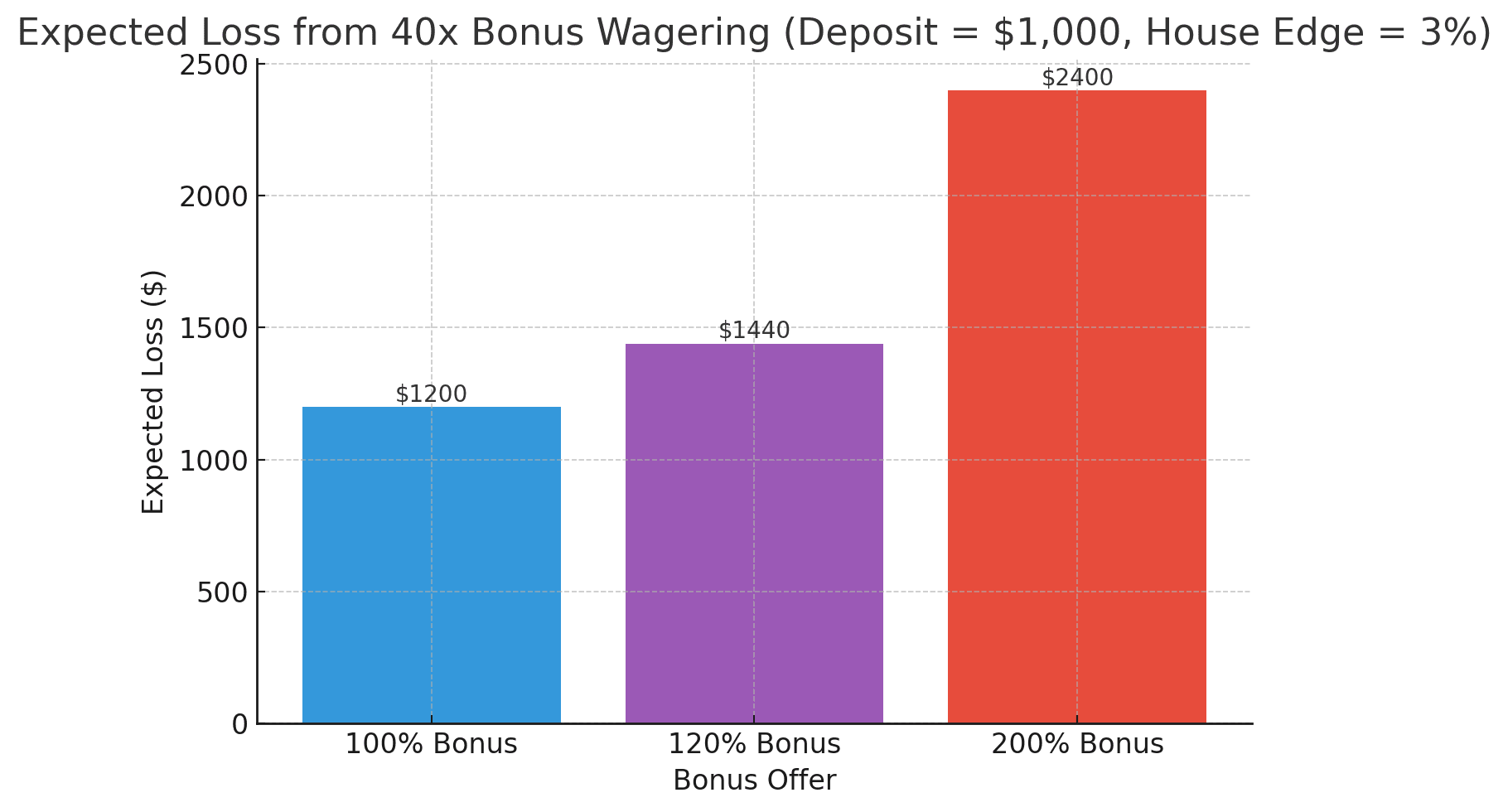
Figure: Expected Loss from 40x Bonus Wagering. With a $1,000 deposit, a 100% bonus creates ~$1,200 in expected loss. At 120%, that grows to ~$1,440. At 200%, you're facing ~$2,400 in losses just to clear wagering. Bigger-looking bonuses don't improve EV; they just scale your obligation.
Example 3: BC.Game's 120% Deposit + Free Spins Offer
BC.Game Casino is another name that comes up when looking for crypto casinos worth testing, but let's see what the math says.
- 120% match up to $1,000 (so a $1,000 deposit = $2,200 balance)
- 20x wagering on deposit + bonus = $44,000 required bets
- At 3% house edge, EV loss = $44,000 × 0.03 = $1,320
And that's before you consider the fine print:
- Free spins capped at $5 maximum winnings
- Free spin winnings require 40x wagering
- Many games contribute only 5% or 0% to wagering progress
- Bonus balance expires in 30 days
👉 The effective EV is even lower than the math shows. In practice, the odds of completing these conditions profitably are near zero.
The Role of Variance
One subtle point about bonuses is variance. How you play affects your short-term results:
- Low-risk strategy: small bets, low volatility games. You'll almost certainly lose slowly until the bonus vanishes.
- High-risk strategy: big bets, volatile slots, or multipliers. You'll bust more often, but in rare cases, you might clear wagering with a big balance.
This is why a handful of players swear they "beat" bonuses. In reality, they just got lucky. Mathematically, variance can only delay the inevitable: the negative EV always wins long-term.
What the Math Doesn't Show You
Everything above assumes a clean scenario: you accept a bonus, complete wagering, and withdraw whatever remains. The EV calculation treats the casino as a neutral math engine that processes your bets and pays out accordingly.
That's not what happens.
After this article was published, we went deeper. We read the complete bonus terms and conditions of 100 crypto casinos, documenting every clause, prohibition, and penalty. What we found is that the negative EV calculation is actually the optimistic scenario, because it assumes the casino lets you finish wagering and withdraw without interference.
In reality, 25% of the casinos we analyzed reserve the right to confiscate your entire account balance, including your own deposits, for bonus-related violations. And the behaviors that trigger this aren't always obvious exploits. At multiple casinos, using a Martingale betting strategy, reducing your bet size after a big win, or switching games during a wagering session is explicitly classified as bonus abuse.
This means the EV equation has a hidden variable. It's not just:
Net EV = Bonus Value – (Wagering × House Edge)
It's closer to:
Net EV = Bonus Value – (Wagering × House Edge) – (Risk of Confiscation × Amount at Risk)
That third term is impossible to quantify precisely because it depends on how you play, what the casino monitors, and whether your withdrawal triggers a review. But it's real. Players who beat the math through favorable variance can still lose everything if their play pattern gets flagged during the withdrawal audit.
We documented all of this in detail. Our analysis of what 100 casino bonus terms actually contain covers the full scope of prohibited behaviors, penalty tiers, and enforcement mechanisms. Our investigation into how casinos weaponize those rules shows how the definition of "abuse" has expanded to capture increasingly normal play patterns.
The math in this article proves the expected outcome is negative. The policy research proves the casino holds additional tools to make it worse. Together, they make the complete case.
Why Cashback and Rakeback are Superior
This is where loyalty programs and transparent deals come in. A cashback bonus or rakeback program works differently:
- They apply to wagers you've already made.
- They don't lock you into future play.
- They have no wagering requirement.
For example, a 10% rakeback on slots with a 3% house edge reduces your effective edge to 2.7%. That's a real, measurable improvement to your EV. Unlike sign-up welcome bonuses, these deals genuinely help players stretch their bankroll.
Beyond Bonuses: VIP & Transfer Programs
If you're looking for value beyond cashback, consider loyalty and VIP systems. Some VIP crypto casino programs offer long-term rewards like higher rakeback, faster withdrawals, and exclusive perks.
There are even casinos that offer VIP level transfers where your existing status at one platform gets matched at another. This is often a smarter way to get value than chasing a one-time deposit trap.
Expert Section: Advanced EV Analysis
Most players stop at the surface level, "bonus = free money" or "house edge = 3%." But if you're serious about understanding how casinos structure offers, you need to go deeper into the interaction between house edge, variance, and rollover mechanics.
1. The EV Formula for Bonuses
At its simplest, the Expected Value of a bonus under wagering is:
EV=Bonus×(1−HE)^{n}
Where:
- Bonus = starting bonus amount
- HE = house edge of the game
- n = playthrough multiple (rollover count)
This assumes you're playing the bonus balance all-in each round. It demonstrates how EV decays exponentially with wagering. For example, with a 3% HE and 40x playthrough, the formula reduces a $1,000 bonus to ~$301 expected value.
2. Deposit-Linked Bonuses vs. Pure Bonuses
- No-deposit bonus: Worst case, you bust the bonus. EV can be capped at the bonus size.
- Deposit-linked bonus: Your deposit is tied up. Now, EV can go negative because the wagering applies to your deposit as well, not just the "free" funds. This is where casinos flip "free money" into a net drain.
3. Variance and Optimal Strategy
Variance adds a twist. If you grind slowly with low volatility games, you converge toward the negative EV with near certainty. If you push variance (e.g., high-volatility slots or all-in dice bets), you increase your probability of busting but maximize the small chance of clearing the full wagering with a large balance.
Mathematically:
- Low variance = near 100% chance of losing slowly.
- High variance = low chance of winning big, high chance of busting.
- EV remains negative on average.
The casino designs wagering precisely to ensure your expected outcome trends toward loss regardless of strategy.
4. Why Cashback and Rakeback Beat Bonuses
Let's compare:
- A 3% HE slot with a 40x deposit bonus reduces $1,000 into a negative EV situation, where you expect to lose more than the bonus value.
- The same 3% HE slot with 10% rakeback reduces your effective HE to 2.7%. Over thousands of spins, this is a permanent structural advantage to your bankroll.
This is why experienced players prioritize cashback and long-term rakeback deals. They lower the net edge instead of artificially inflating balances.
Final Thoughts: Don't Be Fooled by Big Numbers
Casino bonuses are not gifts. They are engineered retention tools designed to keep you playing while silently eating away at your bankroll. The bigger the bonus, the harsher the wagering, and the lower the EV.
The math in this article proves the expected outcome is negative. But the math only tells half the story. The other half is written in the terms and conditions, where casinos define what counts as abuse, decide the penalties, and act as their own judge. If you want to understand what you're actually agreeing to when you click "accept bonus," read our full analysis of 100 crypto casino bonus policies and our investigation into how enforcement actually works.
If you want to maximize your play, focus on:
- Transparent rewards like cashback programs
- Sustainable value through rakeback
- Long-term compounding through VIP programs and level transfers
- Reading the actual terms before accepting anything
At CryptoGamble, we cut through the marketing. Our crypto gambling guides show you where the real value lies, not where the flashing banners want you to click. The math is clear. The policies are public. Now you have both.
Appendix: Data & Downloads
For players who want to dive deeper into the math, we've prepared two downloadable CSV files with full calculations. These resources are optional, but great for advanced readers who want to test scenarios themselves.
1. EV Decay Table
- Shows how much of a $1 bonus remains after 1x, 5x, 10x, 20x, 40x, 60x, 80x, and 100x rollovers.
- Includes scenarios for 1%, 2%, 3%, and 5% house edges.
- 📥 Download bonus_ev_decay_table.csv
2. Bonus Percentage Comparison
- Models a $1,000 deposit with different bonus percentages (100%, 120%, 200%).
- Assumes 40x rollover at a 3% house edge.
- Includes total balance, required wagering, expected loss, and net EV.
- 📥 Download bonus_percent_ev_table.csv
💡 How to use these files: Open in Excel, Google Sheets, or any CSV viewer. Adjust the house edge (%) or wagering multiplier to test your own scenarios.
Why We Publish This Data
Most crypto gambling affiliate sites only skim the surface. At CryptoGamble, we go deeper, exposing the math, not just the marketing. These resources are for players who want to see exactly how much each condition changes their odds.